

What is Bitcoin Really? A Map Across Eleven Layers
The Question Returns

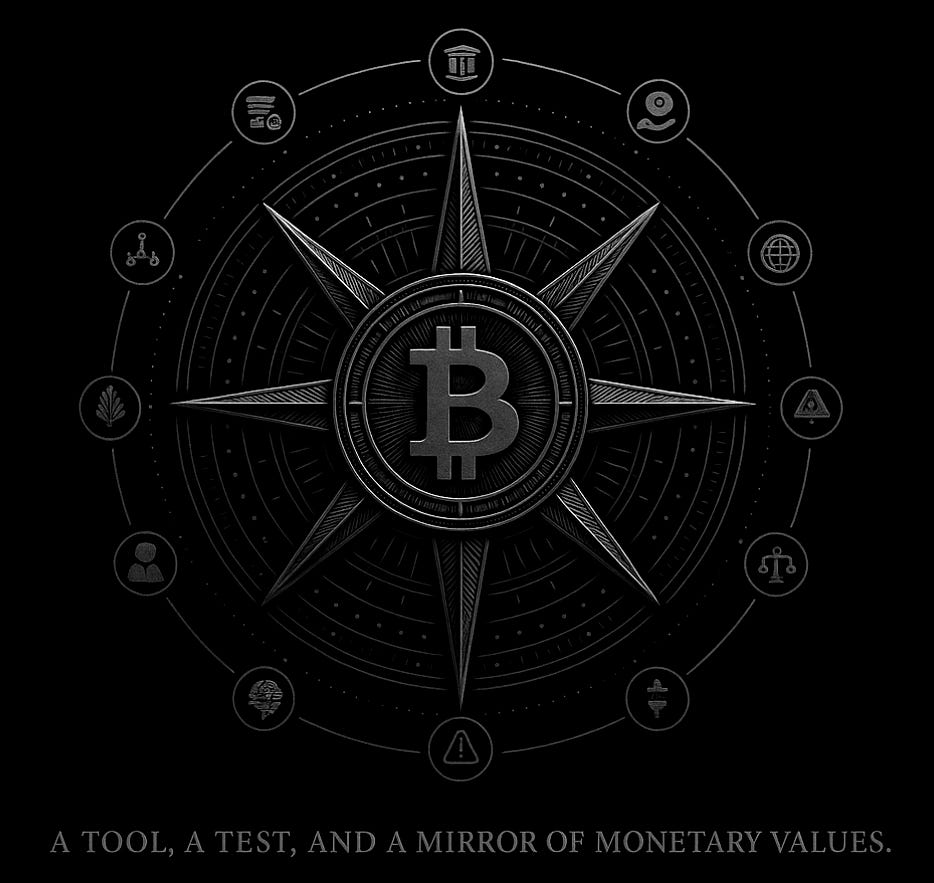
What is Bitcoin really? A Map Across Eleven Layers
Your Quick Entry:
Ask ten people what Bitcoin is, and you’ll get ten different answers.
All partly right, all incomplete.
Bitcoin is not one thing. It is eleven.
It is a protocol, an economic system, a historical event, a philosophical stance, and a political fact.
All at once.
To see it clearly, we need to walk through its layers: from the cryptographic bedrock to the ethical and geopolitical consequences.
This isn’t just about what Bitcoin is.
It’s about what it means and what kind of monetary future we are choosing to build.
1. Technical Layer — Bitcoin as a Protocol
Bitcoin begins as an open, decentralized protocol.Software anyone can run, without permission from any authority.
It operates on a public ledger, the blockchain, where every transaction is recorded and agreed upon by a distributed network of participants.
Its rules are encoded in mathematics and cryptography:
Fixed supply: only 21 million bitcoin will ever exist.
Issuance schedule: new bitcoin are created as block rewards, halving approximately every four years until the reward approaches zero.
Consensus mechanism: Proof of Work — miners expend real energy to solve computational puzzles, securing the network against fraud.
Final settlement: once confirmed, a Bitcoin transaction cannot be reversed.
Bearer asset nature: whoever controls the private keys controls the bitcoin — no intermediaries needed.
Bitcoin is a rule‑set, not a ruler. It enforces its monetary policy automatically, without depending on the goodwill of any central authority.
2. Economic Layer — Bitcoin as Hard Money
In economics, hardness refers to the difficulty of creating new units of a money. Gold is hard because mining more requires significant effort and cost. Fiat money is soft because central banks can create it at will.
Bitcoin is the hardest money in existence:
Supply is absolutely capped.
Creation rate is predictable and publicly known.
The protocol enforces scarcity without human discretion.
It also has the classic monetary properties:
Portability: can be moved across the planet in minutes.
Divisibility: can be split into 100 million satoshis.
Fungibility: each bitcoin unit is interchangeable.
Verifiability: anyone can verify the authenticity of a bitcoin without trusting a third party.
Durability: as digital data, bitcoins don’t degrade; the network is durable as long as the internet and nodes exist.
Crucially, it is the only major asset whose base layer is not a liability. Your bitcoin is not someone else’s debt. This is rare in the modern financial system.
3. Historical Layer — Bitcoin in Monetary Evolution
Money has evolved through distinct eras:
Commodity money: gold, silver, and other physical goods with intrinsic scarcity.
Representative money: paper notes redeemable for commodities.
Fiat money: state‑issued currency backed only by legal decree, not by redeemable assets.
Bitcoin: digitally native, scarce, bearer‑owned, and globally accessible.
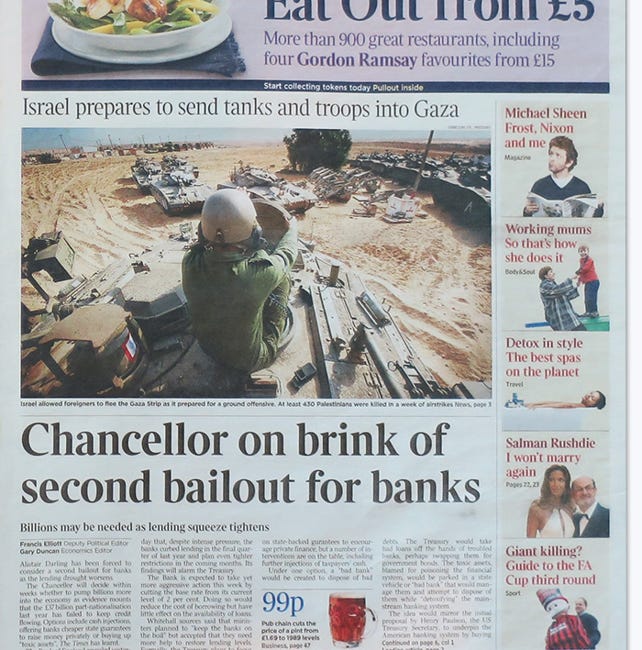
Bitcoin’s Genesis Block, mined by its pseudonymous creator Satoshi Nakamoto on January 3, 2009, contains a message:
“The Times 03/Jan/2009 Chancellor on brink of second bailout for banks.”
This was not an accident. It was a timestamp — and a statement — marking Bitcoin as a direct response to the 2008 financial crisis and the moral hazard of unlimited money creation.
4. Philosophical Layer — Bitcoin as Sovereignty
At its core, Bitcoin is about self‑custody and property rights in the digital realm.
If you hold your private keys, no bank, corporation, or government can seize your bitcoin without your consent.
It is censorship‑resistant: transactions can be sent to anyone, anywhere, without permission.
It runs on neutral rules: the protocol does not care about nationality, wealth, or status.
It offers an exit option from monetary systems that debase currency or restrict capital movement.
In a world where money is often a tool of control, Bitcoin reframes it as a tool of freedom.
5. Psychological Layer — Bitcoin as Paradigm Shift
Owning and using Bitcoin reshapes one’s relationship to time, responsibility, and trust:
Time preference: Holders tend to think in years and decades, not days. Saving becomes rational again.
Self‑responsibility: You are your own bank… which is liberating, but also unforgiving.
Trust minimization: The protocol replaces the need to trust institutions with the ability to verify directly.
Community identity: Bitcoin creates a global culture united by shared principles, not borders.
It is not just a new form of money; it’s a psychological training ground for independence.
6. Systemic Layer — Bitcoin’s Role in the World
Today, Bitcoin functions simultaneously as:
An asset class: traded on global markets, held in portfolios.
A settlement layer: final, cross‑border transfers of value.
A strategic hedge: against currency debasement, inflation, and systemic risk.
An unfinished experiment: a live, evolving network with no guaranteed outcome.
Its systemic role is still fluid, but it is increasingly clear that it is not going away.
7. Critical Counterpoints — Limits & Risks
No honest examination of Bitcoin is complete without addressing its vulnerabilities:
Volatility: prices can swing 50% or more in months.
Adoption curve: mainstream use remains limited compared to traditional money.
Regulatory threats: some governments may restrict use or access.
Technical risks: bugs, network attacks, or unforeseen cryptographic advances.
Centralization risks: mining concentration, reliance on certain infrastructure providers.
Bitcoin is robust, but not invincible.
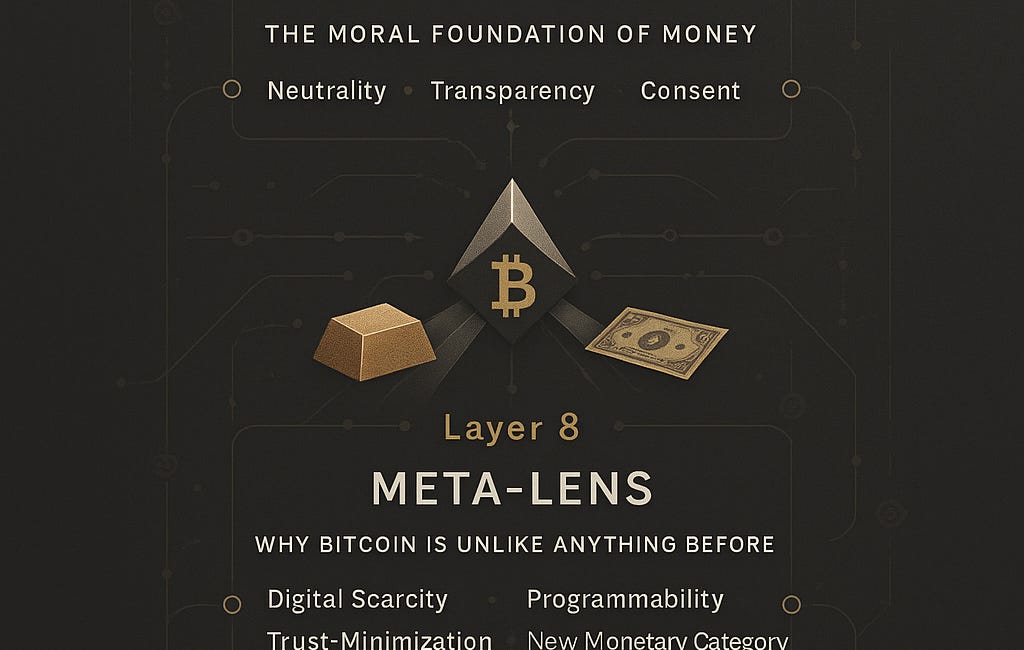
8. Meta‑Lens — Why Bitcoin is Unique?
Bitcoin combines properties no prior money has held in one package:
Scarce like gold.
Portable like data.
Self‑verifiable like open‑source code.
It is not simply “digital gold” or “digital cash” — it is a new category of monetary asset.
9. Ethical Layer — Bitcoin as Moral Money
Bitcoin’s ethical foundation rests on principles many monetary systems lack:
No debasement without consent: no one can inflate supply behind your back.
Equality before the protocol: every user plays by the same rules.
Voluntary participation: no one is forced to use Bitcoin.
Transparency: the code and ledger are public.
No privileged issuance: no insiders get “early” money through political power.
In rules, it is neutral.
In impact, it is radical.
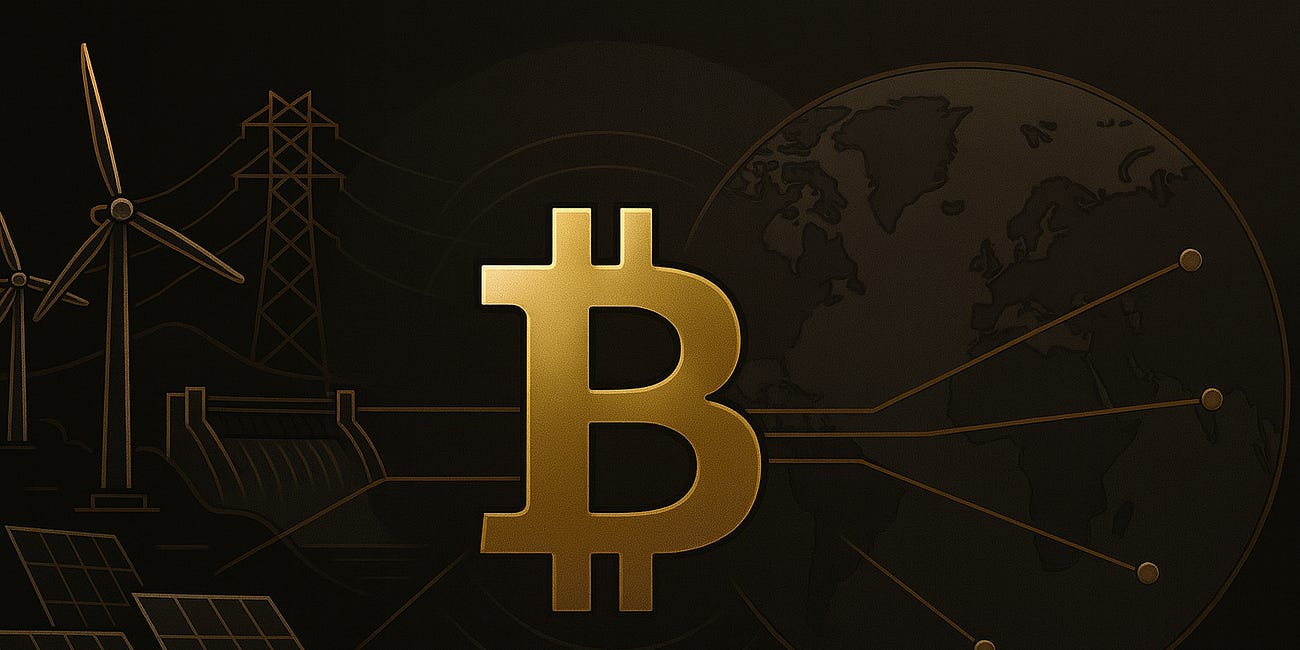
10. Energy & Resource Layer — Bitcoin as a Real‑World Anchor
Proof of Work is often misunderstood.
It is not “waste” — it is energy‑backed security:
It ties Bitcoin’s ledger to the physical world via real‑world costs.
It provides an objective cost basis for rewriting history, which makes such attacks prohibitively expensive.
It can incentivize renewable and stranded energy use, improve grid stability, and monetize wasted power.
In an era of intangible finance, Bitcoin is anchored in the physics of energy.
11. Geopolitical Layer — Bitcoin as a Neutral Reserve Asset
On the global stage:
Bitcoin is non‑aligned: no nation can unilaterally control it.
It is resistant to weaponization: unlike the dollar system, it cannot easily be used to impose sanctions.
It offers small states leverage: a neutral reserve asset beyond the reach of larger powers.
It is emerging as a monetary Switzerland — neutral ground in a multipolar world.
The Question Returns
So, what is Bitcoin?
Technically, it’s an open protocol.
Economically, it’s the hardest money ever created.
Historically, it’s the next chapter in the evolution of money.
Philosophically, it’s sovereignty encoded.
Psychologically, it’s a shift in time and trust.
Systemically, it’s a new piece of global infrastructure.
Ethically, it’s money without masters.
And geopolitically, it’s a neutral reserve for a fragmented world.
But beyond all that, Bitcoin is a mirror.
It reflects back the monetary values we choose to live by.
It asks: Do we want money controlled by rulers, or by rules? Do we want inflation by decree, or scarcity by design? Do we want trust by law, or verification by code?
Bitcoin will not answer these questions for us.
It simply offers a tool… and a test.
What we build with it will depend not on the protocol alone, but on us.
So what do you think?
To go full into all Layer´s there isn´t enough space in one Article.
So i decided to write a Series.
This first piece is the map. The journey starts next
Next: The Deep Layer Series
This was the map. Now we walk the terrain.
In 4 Articles I will go on deepest level and try to answer this Question.
Part 1 — Layers 1–3: The Code, the Money, the Moment in History
BITFORM DEEP —What is Bitcoin Really Part 1? Code, Money, History
·
BITFORM | The Structural Bitcoin Compass
Part 2 — Layers 4–6: Sovereignty, Mindset, and System
BITFORM DEEP —What is Bitcoin Really? Part 2: Philosophical,Psychological,Systemic
·
BITFORM | The Structural Bitcoin Compass
Part 3 — Layers 7–9: Risks, Uniqueness, and Ethics
BITFORM DEEP —What is Bitcoin Really? Part 3: Counterpoints, Uniqueness, Ethics
·
BITFORM | The Structural Bitcoin Compass
Part 4 — Layers 10–11: Energy, Geopolitics, and the Mirror
BITFORM DEEP —What is Bitcoin Really? Part 4: Energy, Geopolitics, and the Mirror
·
BITFORM | The Structural Bitcoin Compass
Thank you for reading. I hope this essay offers clarity, orientation, or at least a sense of the possible.
If you’re ready to move beyond noise and headlines, and want to navigate multi-layer through structural & psychological currents…
Coherence is your compass.
Join now. Don’t predict. Navigate. Structure thinks before reaction.
— Florian Jumel
The Coherence Ledger | Civilisational Drift


Bitcoin mining doesn't really solve complex puzzles, it's simply guessing random numbers to solve an equation
Awesome!