

When the Map Starts to Fail
War, debt, migration, markets, and the hidden struggle between function, truth, and human orientation

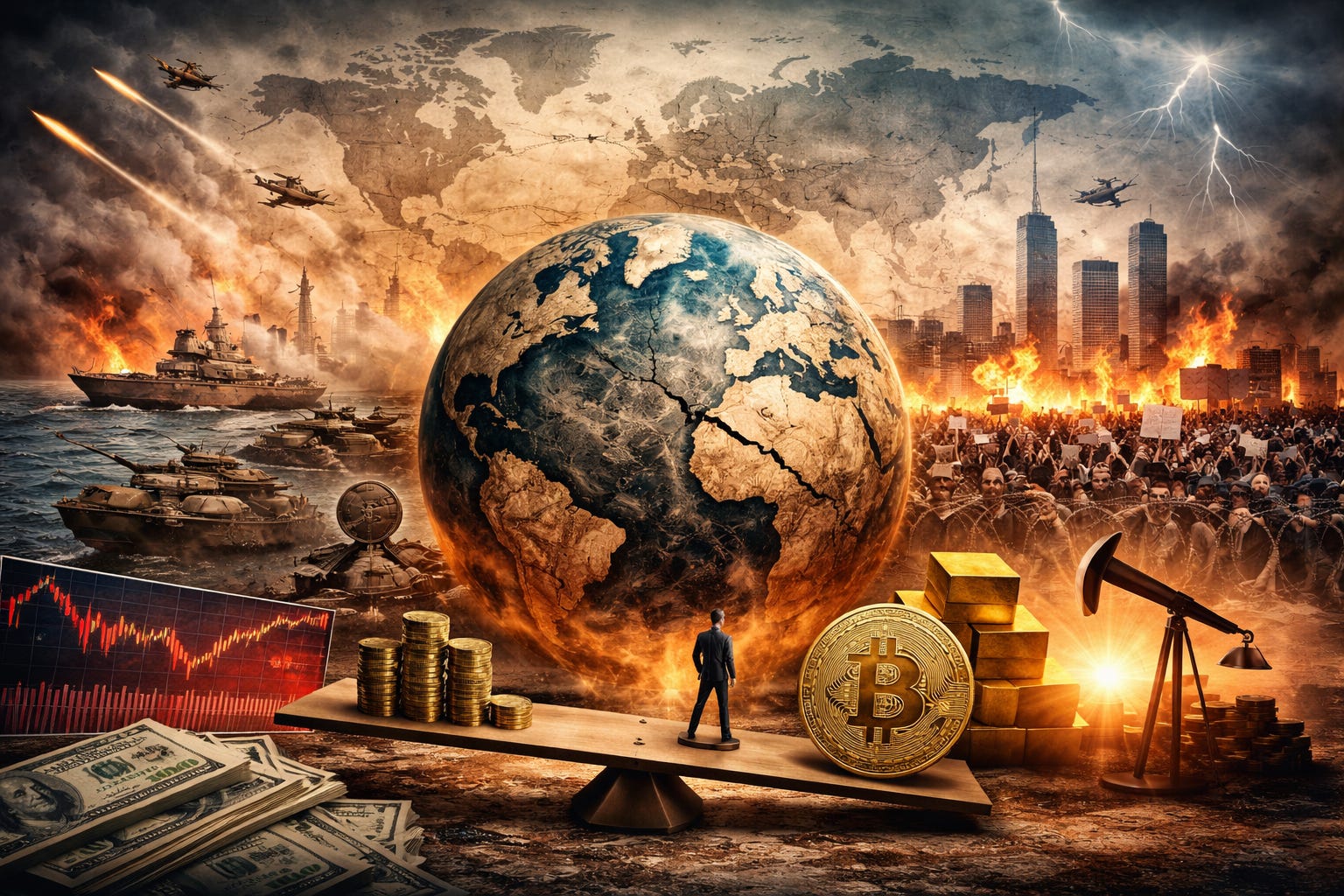
The deepest crisis of an age begins when systems keep working just well enough to hide their drift, while the people inside them grow more exhausted, more suggestible, and less certain where truth, agency, and responsibility still reside.
You do not need a terminal, a policy brief, or a Bloomberg screen to sense that something has shifted.
It is there in the atmosphere long before it appears in a chart. A tightening. A roughness in the field. A subtle loss of trust in the surface of things. Institutions still speak, markets still trade, governments still perform their rituals of control, and yet the deeper impression remains: something about the world has become harder to believe on its own terms.
That impression matters more than most people admit.
The deepest forms of disorder rarely announce themselves through immediate collapse. More often, they arrive as a widening distance between outward function and inward truth. Systems continue. Prices move. Language holds. Procedures remain intact. Yet the living connection between reality and response begins to thin. What once looked stable starts to feel staged. What once felt legible turns strangely opaque. The machinery is still running, but your confidence in what it is actually doing begins to erode.
This is the threshold we are living through now.
If you want to understand the present moment, you cannot afford to read it in isolated layers — not as geopolitics alone, not as economics alone, not as culture war, market cycle, or media distortion alone.
The pressure has become cross-systemic.
War, energy, inflation, debt, migration, political fatigue, monetary distrust, and psychological exhaustion have entered the same circuit. Each intensifies the others. Each translates into the next.
That is why the old categories no longer feel sufficient. They still describe parts of the picture. They no longer hold the whole.
My own work toward a scientific boundary discipline — still unfinished, still evolving — begins from exactly that rupture.
SOCS, or Second-Order Coherence Science, is not a policy model, a management doctrine, or a governance technology. It does something more basic and, in a sense, more severe. It asks under what conditions a system remains capable of truth, capable of orientation, and capable of retaining responsibility at all. Its concern is not merely whether a system performs, but whether it still relates meaningfully to reality rather than substituting metrics, abstractions, institutional theater, or delegated procedure in place of actual contact.
SOSE, or Second-Order Stability Epistemology, builds on that boundary. It treats stability not as continuity, not as performance, and certainly not as the temporary suppression of visible breakdown, but as the ongoing capacity to validate, to adapt, to remain reality-coupled under uncertainty, and to preserve responsibility rather than dissolving it into systems that no longer answer for their own consequences.
That distinction is not academic. It is the heart of the present moment.
The Age of Propagation
What defines this period is not simply that the world is under pressure. It is that many of the structures meant to absorb pressure now show signs of drift while still appearing functional from the outside.
Take the Gulf.
At one level, the story is obvious: military escalation, energy insecurity, higher oil prices, disrupted shipping routes, rising insurance costs. Yet what matters is not only the event itself, but the chain of translation it sets in motion. A conflict in one region becomes a cost structure in another. Energy volatility moves into freight. Freight moves into inflation. Inflation moves into central-bank reaction functions. Rates move into credit conditions. Credit conditions move into household stress, fiscal constraints, and political aggression. None of these steps remain local for long.
This is the first thing I want you to hold clearly:
The danger is no longer contained primarily in events themselves. It lives in the pathways through which events propagate.
What once might have remained regional now arrives almost immediately in the nervous system of the global order. The world has become both more connected and more brittle. It can transmit shocks faster than it can metabolize them.
That same brittleness defines the macroeconomic backdrop.
For years, investors and institutions trained themselves to interpret instability through a familiar sequence: temporary stress, central-bank response, liquidity support, narrative reset, continuation. The script worked often enough to become a habit of mind. But habits of mind become dangerous when the structure beneath them changes. An energy shock inside a debt-heavy system is not the same as a growth scare inside a flexible one.
Debt and the Compression of Time
Debt changes the emotional climate of a civilization.
That may sound poetic, but it is concrete. Debt compresses time. It makes patience more expensive, mistakes less tolerable, and adaptation harder to finance. It narrows the bandwidth for reflection. Individuals experience this as private pressure; states experience it as fiscal rigidity; markets experience it as sensitivity to rates, liquidity, and rollover risk. The result is similar in each case: shorter tempers, thinner margins, harsher reactions.
You can feel that compression everywhere now — in politics, where complexity is punished and simplification rewarded; in media, where interpretation grows more aggressive even as confidence decays; in social life, where many people oscillate between overstimulation and numbness; and in markets, where the same asset may be treated as a safe haven one week and a liquidity proxy the next.
This is why psychology belongs inside any serious analysis of global disorder.
Not as decoration.
Not as empathy language.
As structure.
A population living under prolonged uncertainty does not remain epistemically neutral. It becomes more suggestible, more reactive, more eager for explanatory compression. What cannot be metabolized systemically gets converted psychologically. Diffuse pressure seeks form. Anxiety looks for a face. Fatigue seeks a moral enemy. The mind, pushed beyond its preferred threshold of complexity, begins to bargain for relief through blame, ideology, certainty, tribal belonging, or procedural obedience.
You can watch this process unfold in the way migration is discussed, political elites are imagined, institutions are judged, markets are moralized, and wealth is symbolically interpreted. The material and the symbolic no longer sit apart. They collapse into one another.
Under those conditions, politics hardens almost automatically. Administrative systems become stricter. Borders become symbols. Elections become emotional loading zones. The issue is never simply what people think; it is the pressure under which they are forced to think.
And this is where most commentary fails. It describes positions without describing the psychic economy that produces them.
Stability That Drifts
SOSE pushes the analysis further. It asks not whether a system still operates, but what kind of distortion is now required for it to keep operating. That is a much sharper question.
A state may preserve order by becoming more procedural and less reflective.
Markets may preserve liquidity by becoming more narrative-driven and less reality-sensitive.
An institution may preserve legitimacy through communication management while losing genuine feedback from its environment.
A society may preserve outward normality by distributing rising stress into private exhaustion rather than public rupture.
All of these count, in ordinary language, as forms of stability.
From a second-order perspective, they may be forms of delayed instability.
That is what I mean by false stabilization: not theatrical collapse postponed by luck, but deeper drift concealed by continuing function.
What Markets Are Really Saying
The asset layer reveals this especially clearly.
Oil is the most direct translator of present danger. It carries the signal of physical vulnerability, route insecurity, insurance strain, and inflationary transmission all at once. Its meaning in this regime is brutally simple: civilization remains materially exposed.
Bonds tell a subtler story. When geopolitical stress coincides with rising yields, something important is being communicated. The market is not reading the moment as a clean flight to safety. It is reading inflation persistence, debt burden, and constrained policy flexibility. In other words, safety itself has become conditional.
Gold, often treated as the automatic mirror of fear, is more conditional than its mythology suggests. When real-rate expectations rise and the dollar strengthens, even war does not guarantee a simple upside response. The implication is not that gold has failed, but that the dominant fear in the short run is not yet pure monetary disbelief. It is the harder financial mechanics of rates, dollar pressure, and liquidity need.
And then there is Bitcoin.
Bitcoin remains one of the clearest examples of how badly modern discourse handles multi-regime assets. People keep trying to make it singular. It is not singular.
At times, it behaves like high-beta liquidity. When the system tightens, yields rise, and macro funds de-risk, Bitcoin can fall with the rest of the speculative complex. Yet to stop there is to miss the deeper layer.
Bitcoin is also a monetary object outside the structure of state liability, outside the cash-flow logic of equities, outside the refinancing dependency of bonds, and outside the extraction logic of central-bank discretion. That does not place it beyond volatility or narrative capture. It does, however, give it a structural distinctness that becomes increasingly visible as confidence in the broader debt-governance regime weakens.
So the right question is not, “Is Bitcoin risk-on or digital gold?”
The real question is which function of Bitcoin is being selected by the regime.
When liquidity dominates, Bitcoin behaves one way. When sovereign distrust dominates, it behaves another. When monetary debasement becomes the core fear, another layer activates. And when the crisis becomes civilizational
— not merely financial, but existentially about agency, custody, and dependence — Bitcoin begins to be read as a sovereignty asset.
Not universally.
Not on every timeframe.
Not in a straight line.
That multiplicity is precisely the point.
The same is true, differently, of all major assets. Markets do not merely move; they disclose which layer of fear has become dominant. Oil discloses exposure. Bonds disclose policy limits. Gold discloses the contest between distrust and rates. Bitcoin discloses the unstable boundary between liquidity, hardness, and sovereign self-custody.
The Question Beneath the Price
And beneath all of them sits the same deeper question: where, now, does responsibility actually reside?
This is where SOCS becomes especially severe. One of its most important boundary claims is that decision locus cannot be alienated indefinitely without degrading the epistemic integrity of the system. Put plainly: a civilization cannot outsource responsibility forever — not to models, institutions, markets, procedures, or abstract necessity — without eventually losing its grip on truth.
That is the hidden emotional wound of the present era.
People feel acted upon.
Managed.
Processed.
Priced.
Sorted.
Mapped.
Optimized.
But not genuinely represented in the place where reality is interpreted and decisions are owned.
This is not merely political alienation. It is epistemic estrangement. And once a population begins to feel that estrangement deeply enough, it will search for recovery in one of three places: submission, aggression, or sovereignty.
Submission says: tell me what to believe.
Aggression says: give me someone to blame.
Sovereignty says: I must rebuild contact with reality directly.
Much of the turbulence of this era is the struggle between those three responses.
What This Period Is Really Testing
So where does this leave us?
Probably not at the edge of immediate civilizational collapse. That temptation should be resisted. The more likely path is harsher and slower: prolonged tension, thinner margins, harder politics, less strategic grace, more expensive error, and a widening gap between visible function and inner coherence. Systems will continue. Many will appear resilient. But what they preserve outwardly, they may be losing inwardly.
That is why the real distinction now is not between stable and unstable systems in the ordinary sense.
It is between systems that remain reality-coupled and systems that survive by drifting.
If you are reading this carefully, you may already know which of those worries you more.
Not the crash everyone can see.
The continuity that conceals decay.
Order that remains impressive while becoming less truthful.
Structure that still performs while slowly forfeiting the capacity to orient.
That, more than any single war, election, or market move, is the defining pressure of this period.
And perhaps that is also why so many people feel tired in ways they cannot fully explain. They are not only carrying the weight of events. They are carrying the burden of interpretation inside an order that increasingly asks them to treat performance as proof.
You should resist that invitation.
Not with paranoia, cynicism or ideological intoxication.
But with a stricter standard of reading, a greater seriousness about coherence, and a clearer attention to what is real, what is staged, what is transferred, what is displaced, and what is no longer being owned by anyone able to answer for it.
Because the decisive question of this moment is not whether the world can keep functioning.
It is whether it can keep functioning without losing contact with the conditions that made it viable in the first place.
That is the test beneath geopolitics, beneath macroeconomics, beneath social fracture, beneath Bitcoin, beneath markets, and beneath the unease you feel when the map no longer matches the terrain.
And the answer will not be found in whichever system shouts stability the loudest.
It will be found in whichever one still knows how to tell the truth while under pressure.
Because the real break rarely begins where collapse is most visible.
It begins where continuity becomes more important than contact, where performance becomes more persuasive than reality, and where systems learn to survive by drifting out of the truth they still claim to defend.
That is when the map starts to fail. And that is when the work of reorientation begins. What comes next will not be decided only from above, nor will it rise by itself from below. It will be shaped wherever responsibility is taken up again — by people willing to carry truth, judgment, and consequence deeply enough to help remake the world around them.
For readers who want to follow one thread more deeply — the chokepoint logic of energy, monetary stress, and the migration of capital toward harder forms of scarcity — I explore that axis more directly in The $100 Chokepoint.