

The Invisible Escalation Point
Energy, Deterrence, Money, and Why Modern Wars Begin Before Anyone Wants to Fight

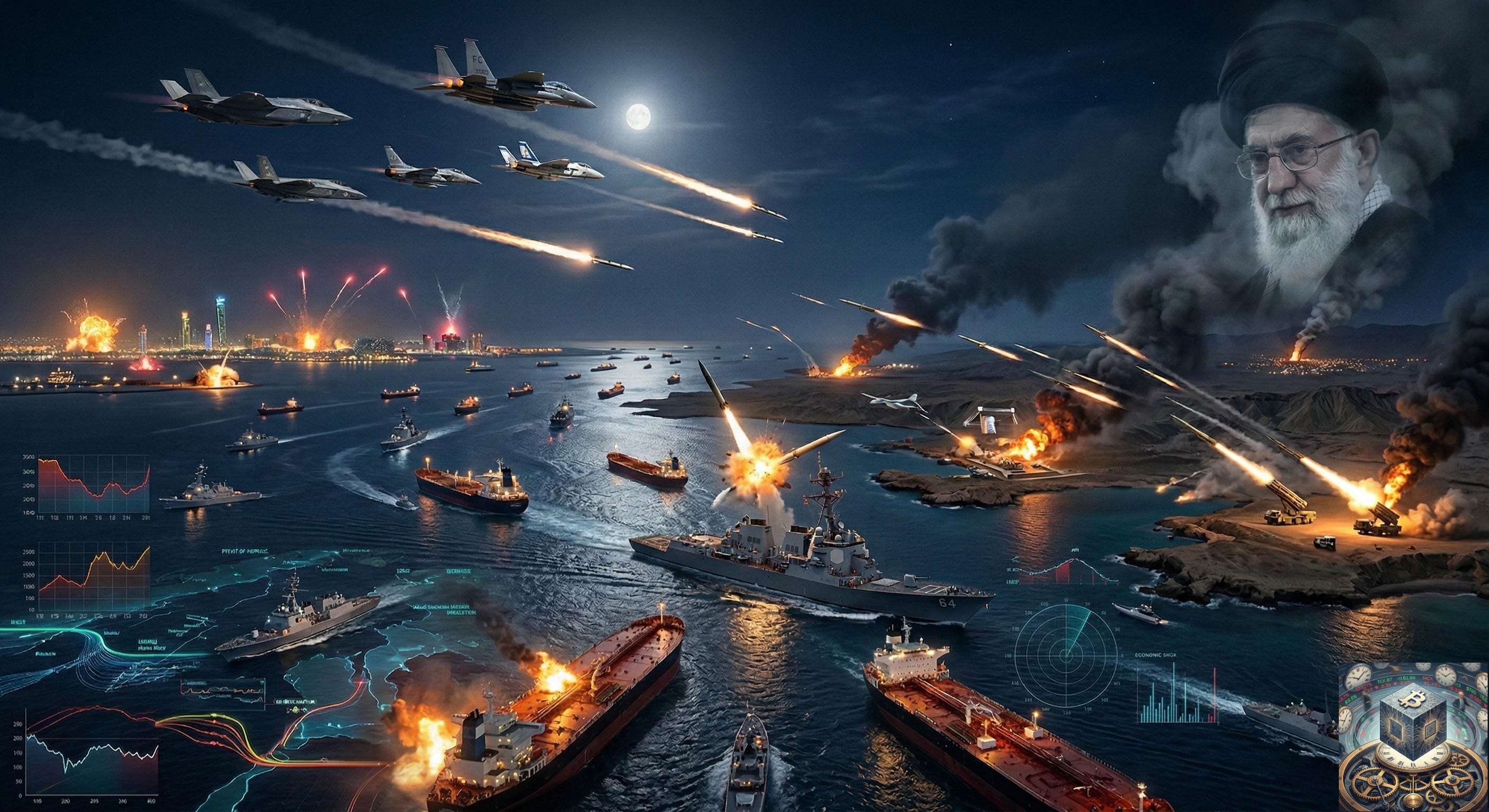
When a war breaks out, people instinctively search for a clear beginning:
Who started it, what was the exact trigger, and who bears the responsibility?
Yet, looking back at conflicts from July 1914 to more recent regional crises, leaders on all sides often believed they were acting defensively. Each step appeared limited and rational, ultimately marking the beginning of wars no one explicitly intended to start. Most contemporary wars do not begin with a single, isolated decision. They originate when multiple stability systems weaken simultaneously, leading to a gradual narrowing of available choices. The current confrontation involving Iran, Israel, and external powers shows exactly this pattern. Escalation here doesn’t feel like choosing war; it feels like trying to prevent a future in which no acceptable options remain.
It is a condition where uncertainty about the future finally outweighs the immediate costs of conflict, and waiting appears riskier than taking action.
The Neighborhood Problem and the Security Dilemma
To understand this dynamic, we can imagine two neighbors who deeply distrust each other. One installs a reinforced door and cameras to feel secure. The other neighbor observes this and fears that he might soon be completely defenseless if the first neighbor ever decides to lock him out. Consequently, he also upgrades his security systems. Although neither initially had the intention to attack, they mutually restrict their future freedom of action, and tension inevitably rises. This is exactly how deterrence works between states. Missile defense systems, long range weapons programs, or preventive strikes often do not stem from a primarily aggressive intent, but from a deep fear of future helplessness. Wars frequently begin not because someone desperately wants to fight, but because the fear grows of soon being unable to react. Political science calls this the security dilemma.
The Shadow War
Modern conflicts rarely erupt openly right away. In our neighborhood example, the rivals would not confront each other directly, but would support different groups in the district. Minor frictions constantly occur, but the neighbors themselves officially remain at peace. This logic of proxy conflicts encompasses sabotage, cyber operations, and covert attacks below the threshold of war. Such conflicts can remain stable for years. They only become dangerous when one side gets the feeling that control is slipping away. At that precise moment, direct confrontation suddenly becomes rational, not out of pure aggression, but out of immense time pressure.
Alliances and the Insurance Principle
Distant great powers interfere in regional conflicts because alliances function like insurance policies. If an insurer defaults even once, trust vanishes everywhere. Great powers therefore react not only to the local opponent, but also to the global audience watching the credibility of their commitments closely. A regional conflict expands globally the moment other states begin to evaluate whether old promises still hold. Wars are thus often fought not over territory, but over reputation.
Sanctions as a Frozen Bank Account
The modern international order prefers economic pressure over open war. The underlying logic is simple. Access to trade promotes cooperative behavior, while the loss of this access forces adaptation. Sanctions essentially act like a frozen bank account on a planetary scale. However, the system falters when the sanctioned actor finds ways to generate value outside the traditional banking system. The pressure remains, but becomes unreliable, and any form of deterrence depends fundamentally on its reliability.
The Resource Layer
It is often claimed that conflicts in the Middle East revolve primarily around oil. This is misleading, because it is not about the mere possession of resources, but about strategic influence over their flows. Oil is essential for transport, logistics, and industrial supply chains. Natural gas powers electricity grids and heavy industry. Petrochemical derivatives are indispensable for plastics and pharmaceuticals, while uranium serves primarily for strategic deterrence. None of these resources causes a war on its own. The decisive factor is rather whether they can be used as political leverage.
The Chokepoint
A significant portion of global energy trade passes through narrow maritime routes. Let us imagine a neighborhood where a single house controls the main water valve. It does not even need to close the valve, because the mere possibility that this could happen changes the behavior of all residents. Energy geopolitics operates on exactly this principle. It is not the actual interruption, but the potential interruption that destabilizes systems, since markets react to expectations and not just to events that have already occurred.
The Monetary Layer
The energy trade simultaneously stabilizes financial systems. Large parts of global commodity trade support the demand for specific currencies and government bonds. Energy flows are therefore not just physical infrastructure, but an essential component of the global monetary architecture. If settlement channels diversify, influence shifts gradually and structurally.
Technology and Digital Value
Here a new, crucial factor comes into play. Historically, states needed partners to convert resources into purchasing power. But if electricity can be converted into globally transferable, digital value, such as through state sponsored crypto mining, a limited form of economic agency emerges without full financial integration. While this does not replace an entire economy, it radically weakens predictability. Since predictability is the foundation of deterrence, rapid action becomes more attractive when the economic pressure of tomorrow could foreseeably come to nothing today.
Ideology and Irrationality
Amidst all this systemic logic, one crucial factor must not be overlooked. A purely structural perspective falsely suggests that wars are always the result of cool, rational risk assessments. In reality, however, decision makers are often driven by irrational motives, deeply rooted historical grievances, hubris, or apocalyptic religious goals. These factors can bring about an escalation entirely independent of systemic constraints. Individual agency, as well as the sheer incompetence and misjudgment of individual political leaders, often plays a far more dramatic role than structural theoretical models allow.
The Time Horizon
If we consider a simple scenario where a state can still influence its rival today, but will probably no longer be able to do so in five years, this state does not act because war is desirable per se. It acts because further waiting would strip it of any choice. Historically speaking, many wars began shortly before the balance of power would have shifted drastically. It is therefore uncertainty, and not pure strength, that breeds conflict.
Psychology and Narrative Compression
Societies are hardly capable of fully processing such complex systemic causalities. Therefore, conflicts are translated for the public into simple narratives dealing with attack, defense, and retaliation. These stories are not pure deception, but a necessary compression of reality. The true drivers like risk asymmetry, loss aversion, and uncertainty about the future are often too abstract for collective decision making. People are more likely to accept far reaching actions if they are made morally comprehensible, even if they are not necessarily optimal strategically.
Competing Interpretations
Different schools of thought explain the same conflict entirely differently. The realist perspective emphasizes the balance of power and the failure of deterrence. The economic perspective sees weakening pressure mechanisms, while the domestic political view focuses on the survival incentives of the leadership. The technological perspective, in turn, analyzes how autonomy alters timelines. None of these explanations is sufficient on its own. Only in their entirety do they describe the complex reality.
A modern war rarely begins with a single, isolated cause. It erupts when various stabilizers fail simultaneously. When deterrence becomes uncertain, proxy conflicts spiral out of control, alliances must demonstrate their strength, economic pressure loses its reliability, resource flows appear vulnerable, and technological autonomy increases. If ideological zeal and the irrational decisions of human actors are added to this mix, escalation is no longer perceived as a conscious choice, but mistakenly as the lesser risk. Consequently, wars do not simply begin when leaders want to fight. They begin when leaders fear they will soon have no other choice.
As of today, February 28, 2026, the theoretical “invisible escalation point” described in this excerpt has officially been crossed. The United States and Israel have launched a major, direct military campaign against Iran, and Tehran has retaliated with massive strikes across the region.
Here is how the core concepts from the text map directly onto today’s breaking realities:
1. The “Ideology and Regime Survival” Layer is Now the Primary Driver
The initial strikes—dubbed “Operation Epic Fury” by the US and “Operation Lion’s Roar” by Israel—were not just about degrading nuclear capabilities after the collapse of talks in Geneva. They were designed for regime decapitation. With President Trump announcing the death of Supreme Leader Ayatollah Ali Khamenei and explicitly urging the Iranian people to “take over your government,” the conflict has bypassed standard military deterrence. For Iran’s surviving leadership and the IRGC, this is now a purely existential fight, which makes traditional diplomatic off-ramps or de-escalation nearly impossible.
2. The Shadow War and Alliance “Insurance” Have Collapsed
The era of proxy warfare is officially over, and the conflict has instantly regionalized. Iran’s retaliation was not limited to Israel; it directly tested the “insurance principle” of US alliances by striking the broader American security architecture in the Gulf. Ballistic missiles and drones have targeted the US 5th Fleet headquarters in Bahrain, Al Dhafra Air Base in the UAE, and Al Udeid in Qatar. Tehran is signaling that the entire neighborhood is now the battlefield, dragging previously cautious Gulf states into the crossfire.
3. The Chokepoint Reality is Active
Just as the framework outlines that the mere potential for interruption destabilizes systems, Iran has already weaponized its geography. Tehran has issued warnings regarding the closure of the Strait of Hormuz. With roughly a third of total worldwide seaborne oil exports passing through that narrow corridor, global markets are already bracing for severe supply chain shocks, proving that energy flows are indeed being used as structural leverage.
4. The Immediate Human Shockwave
Beyond the macro-level calculus of regime survival and global alliances, the collapse of these stability systems has an immediate, devastating translation on the ground. The theoretical "narrowing of choices" is now mirrored by the literal trapping of civilian populations. With airspace completely shuttered across the Middle East and mass flight from major urban centers, the abstract failure of deterrence has instantly become a severe humanitarian crisis. The sheer speed of this escalation leaves millions navigating the terrifying reality of a war born from systemic erosion. While leaders calculate strategic leverage and chokepoints, it is the civilian population that bears the immediate, brutal cost of these failing stabilizers.
The Hidden Engine of Escalation
The events of the past 48 hours have shattered the illusion of traditional deterrence. We are watching the kinetic reality of a systemic collapse unfold in real-time. But beneath the ballistic missile exchanges, the shuttered airspaces, and the diplomatic paralysis, a quiet, parallel war is being waged. It is a war that explains exactly why targeted regimes can afford to cross the invisible escalation point in the first place, despite facing the most severe economic blockades in modern history. For decades, the ultimate geopolitical threat was total financial exile. Today, that threat is obsolete.
In the following exclusive section for premium subscribers, we dive into the specific technological mechanism driving this unprecedented defiance. We will explore the “Sovereign Escape Hatch” and analyze exactly how state actors are weaponizing decentralized digital value to bypass the global banking system. By transforming stranded energy into unseizable purchasing power, they are not just evading sanctions, they are fundamentally rewriting the rules of modern warfare.
