

The Consortium and the Institutionalization of Bitcoin Security
On funding, influence, and the fragile line between support and authority

Some announcements change the price. Others change the atmosphere around the thing being priced.
The Bitcoin Security Consortium belongs to the second kind.
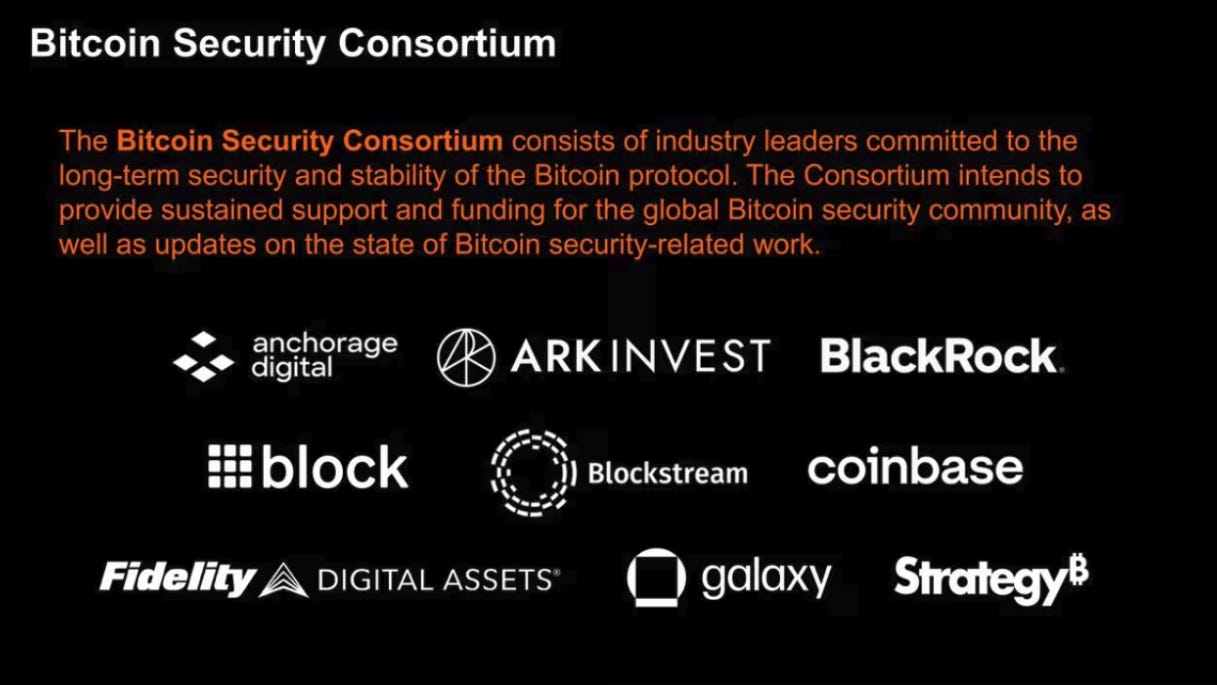
No chart erupted when the names appeared together. There was no clean candle to point to, no sudden rush of volume, no event that could be translated into the simple grammar markets prefer. BlackRock, Fidelity Digital Assets, Coinbase, Blockstream, Galaxy, Strategy, ARK Invest, Anchorage Digital, Block. A group of firms committing money, attention, and public legitimacy to the long term security of Bitcoin.
On the surface, it looked almost restrained.
Yet the names were loud enough.
For most people, Bitcoin security remains invisible until something threatens it. They watch price, flows, treasury purchases, liquidations, policy, interest rates, political theater, and the endless migration of conviction from one chart to another. Beneath that spectacle, however, lies the quieter work without which none of it would matter for long. Code is reviewed. Assumptions are challenged. Failure modes are imagined before they exist. People spend years studying weaknesses that the market may never notice, precisely because someone noticed them early enough.
From a distance, Bitcoin can look complete.
It is not complete.
Its stability comes from how difficult change is, from the resistance built into the culture, from the suspicion directed at easy answers, and from the patience of people whose names rarely appear beside the companies now entering the room.
Perhaps that is why the Consortium matters more than the sum attached to it. Fifteen million dollars over three years is meaningful, but not enormous when measured against the value of the network. The deeper signal lies elsewhere. Institutions that once treated Bitcoin security as a given have begun to treat it as a responsibility.
That shift deserves attention.
A monetary network valued in the hundreds of billions cannot depend forever on gratitude, volunteerism, scattered grants, and the hope that enough capable people will remain willing to defend the commons while everyone else monetizes the asset built upon it. There has always been something faintly absurd in the contrast between Bitcoin’s market value and the precarious visibility of the work that protects its credibility.
Now that imbalance is becoming harder to ignore.
There is a strong reading of the Consortium, and it should not be diminished merely because caution sounds more sophisticated. Long term funding can give researchers room to think beyond the next crisis. Developers may gain continuity. Security work can become less dependent on bursts of attention that arrive only after fear has already shaped the public conversation. Quantum readiness, protocol resilience, education, review, and open source support can be treated as enduring work rather than emergency theater.
This is maturity, though not the glamorous kind.
It looks like maintenance.
It looks like preparation.
It looks like institutions admitting that their products, treasuries, custody businesses, and client promises ultimately rest on a protocol they do not own and cannot repair by executive decision.
That admission is healthy.
Still, maturity rarely arrives alone. It brings its own gravity.
The institutions funding Bitcoin security are not merely observing the system from outside anymore. Their capital, legal departments, clients, media reach, and regulatory relationships place them within the wider conversation, even if they possess no special authority over consensus. Nothing in the Consortium gives BlackRock the power to rewrite Bitcoin. Coinbase cannot declare a rule valid because it funded research. Strategy cannot turn its balance sheet into protocol law. Fidelity cannot persuade a node to accept what the node rejects.
Bitcoin remains difficult to govern for exactly this reason. Wealth does not pass cleanly into rulemaking power.
Yet influence has subtler forms.
A conversation can change before a line of code does. Certain risks begin to appear serious because serious institutions repeat them. Particular solutions become respectable because they fit the language of boards, regulators, custodians, and insurers. Objections that once sounded prudent may be recast as obstruction. A timeline can begin to feel inevitable long before broad consensus exists.
None of this requires conspiracy.
Gravity does not need intention.
It only needs mass.
Quantum security makes this tension especially clear. For years, the subject drifted between dismissal and apocalypse, two forms of intellectual laziness that protect people from having to remain inside uncertainty. One camp treated quantum risk as theater, as though cryptography were exempt from time. Another spoke as if Bitcoin might be emptied by a machine arriving next Tuesday.
The truth is less dramatic and less comforting.
No operational quantum system appears capable of breaking Bitcoin’s signatures today. At the same time, cryptographic assumptions are not sacred objects. They are engineered defenses, powerful because the cost of attack exceeds what current machines can achieve. If that balance changes, Bitcoin will need more than confidence. It will need research, migration paths, careful design, and a social process strong enough to resist both denial and panic.
Preparation should begin before urgency makes thought impossible.
That is the constructive meaning of the Consortium. It brings a distant risk closer without pretending the catastrophe has already arrived. It makes room for long horizon thinking in a market that usually rewards the opposite.
But the quantum question does not stop at cryptography.
Eventually it reaches property.
Old coins sit behind old assumptions. Some public keys are exposed. Some addresses have remained silent for more than a decade. Satoshi’s coins hover over the whole debate because they are not merely large. They have become a kind of founding absence, a fortune that has never asked to be interpreted.
A migration toward quantum resistant signatures would therefore force Bitcoin to confront questions for which code alone cannot provide an innocent answer. What happens to coins whose owners do not migrate? What if they cannot migrate? Should vulnerable spend paths remain open forever, even if an attacker may one day exploit them? Would restricting those paths protect ownership or interfere with it?
There is no clean place to stand.
Doing nothing may leave property exposed.
Acting too aggressively may make property conditional.
The Consortium does not resolve this conflict, and its official language is careful not to pretend otherwise. Yet by placing institutional money around long term security, it brings these questions closer to the center of Bitcoin’s future. Security work becomes more visible. So does the power to frame what security means.
This is where the room changes.
A custodian wants Bitcoin secure because clients depend on it. An ETF issuer wants the network credible because products depend on it. A public company wants resilience because its treasury depends on it. An asset manager wants risks that can be explained, modeled, and defended before a board.
The Bitcoiner wants something related, but not identical.
He wants sovereignty.
During easy years, these interests appear almost indistinguishable. Everyone benefits from higher prices, deeper liquidity, better infrastructure, fewer failures, and stronger confidence. Alignment feels natural because the market rewards everyone at once.
Stress reveals the differences.
An institution may prefer a migration schedule that provides legal clarity and operational certainty. A developer may see dangerous assumptions hidden inside that certainty. A node runner may prefer years of delay to a rushed change. A sovereign holder may accept ambiguity rather than hand a precedent to those who believe security should always be legible to authority.
No side needs to be malicious for the conflict to become serious.
Bitcoin’s hardest disagreements have rarely depended on villains. They emerge when different forms of responsibility collide, each carrying enough truth to make compromise dangerous.
The Consortium enters that landscape with a genuine strength. It can fund work that deserves funding. It can help people think ahead. It can make security less dependent on heroism and personal exhaustion. It can improve the public language around threats that are too often reduced to fear or mockery.
At the same time, the presence of large institutions will change the texture of the conversation, even if no one intends to direct it. Their vocabulary will travel further. Their risk categories will feel more official. Their concerns will reach lawmakers, journalists, investors, and courts more easily than the concerns of an anonymous node operator or an unfunded researcher.
That influence may often be useful.
It should never become invisible.
Bitcoin can accept institutional support. What it cannot afford is the quiet assumption that institutional seriousness defines Bitcoin seriousness.
The difference may seem narrow until a crisis arrives.
Funding is not authority.
Concern is not mandate.
Coordination is not consensus.
These distinctions sound obvious when nothing is at stake. Under pressure, they blur quickly.
The healthy version of the Consortium would understand its own limits. It would support open research without preferring outcomes. It would finance scrutiny, including scrutiny directed at the institutions themselves. It would resist the temptation to become a public voice for Bitcoin, because Bitcoin has no single voice and should not acquire one merely because the market finds plurality inconvenient.
Such restraint would make the Consortium more credible, not less.
The danger lies less in overt control than in substitution. Once institutions begin speaking about security in language the wider world understands, their description can slowly replace the thing being described. Bitcoin becomes a managed risk category rather than a sovereign protocol. Security becomes compliance with an expected roadmap. Prudence becomes whatever reduces institutional uncertainty.
That would not happen overnight. Nothing important does.
It would happen through accumulated convenience.
A little more clarity, alittle more coordination and also a little less tolerance for unresolved questions.
Then one day the network might still look decentralized while the acceptable imagination around its future has narrowed considerably.
This outcome is not inevitable. Bitcoin’s culture remains difficult, skeptical, fragmented, and resistant to polished consensus. These qualities often make it appear immature to outsiders. In reality, some of them are part of its defense.
Suspicion is not always wisdom, but a system designed to resist capture cannot survive without it.
The Consortium will therefore be healthiest if it meets neither gratitude nor paranoia, but wakefulness. Money can be accepted without moral debt. Research can be welcomed without surrendering judgment. Institutional incentives can align with Bitcoin’s survival while remaining separate from Bitcoin’s deeper commitment to sovereignty.
That separation needs to stay visible.
The next phase of Bitcoin will not be adequately described by the word adoption. Adoption suggests more people using something that remains unchanged by their arrival. What is happening now is more complicated. Bitcoin is being surrounded by financial structures that want access to its monetary qualities while translating its risks into the language of the existing world.
Custody makes Bitcoin legible.
ETFs make it allocatable.
Treasury strategies make it corporate.
Security consortiums make it governable enough to discuss in institutional rooms.
None of these developments necessarily alter the protocol. Together, they alter the environment in which the protocol must remain itself.
That may strengthen Bitcoin.
It may also test whether the center is harder than the architecture being built around it.
The Bitcoin Security Consortium is therefore neither proof of capture nor a simple bullish milestone. It is evidence that Bitcoin has grown too consequential for its deepest security work to remain culturally peripheral. Institutions now care about the protocol’s long future because their own interests have become entangled with it.
Their concern is useful.
Their presence is consequential.
The distinction between those two facts will shape what comes next.
For the moment, the line remains clear enough. The Consortium can fund, convene, publish, and support. It can help prepare Bitcoin for threats that deserve sober attention. What it cannot do is inherit the authority of the network merely by helping pay for its defense.
Bitcoin does not need institutions to love its principles.
It needs their incentives to remain subordinate to them.
The Consortium may prove that this balance is possible. Perhaps institutional capital can strengthen open source security without domesticating the system it protects. Perhaps support can remain support, and the institutions can remain aware that Bitcoin’s value comes partly from the fact that no institution, however large, gets the final word.
That would be a meaningful achievement.
It would also be a fragile one.
Something has changed in the room. Bitcoin security is no longer a concern kept mostly among developers, cryptographers, and those who understood early that sovereignty without maintenance becomes mythology.
The institutions have arrived.
Now the more interesting question begins.
Not whether they can help Bitcoin endure.
Whether Bitcoin can accept their help without learning to obey.