

The 95% Collision
Why Bitcoin’s Monetary Expansion is Over and How Global Sovereigns Are Cornering the Final 5%.

19,900,000 Coins.
1 Global Squeeze.
Welcome to Bitcoin’s Supply Shock Era.

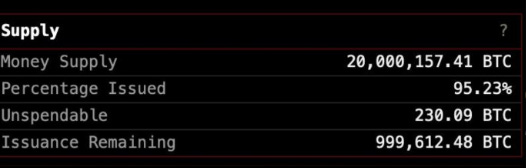
The world is waiting for a financial revolution, but it already happened in silence. As of early 2026, over 95% of all Bitcoin that will ever exist has already been mined. We have officially transitioned from an era of monetary expansion to an era of fierce, global competition for a closed system.
While many retail investors are distracted by daily price volatility, Wall Street ETFs, corporate treasuries, and nation-states are quietly vacuuming up the remaining liquid supply.
The collision between infinite fiat expansion and a hard cap of 21,000,000 coins is here.
Dive into to understand the mathematics of absolute scarcity, the illusion of liquidity, and what happens next when the global financial system runs out of physical supply.
95% of Bitcoin Already Exists and the World Is Only Beginning to Notice
Most revolutions announce themselves loudly. Political revolutions erupt in protests. Technological revolutions arrive with product launches. Financial revolutions usually appear in crises.
Bitcoin did not. Its most important structural change is happening quietly.
No headlines. No global announcement. Yet a threshold has been crossed that fundamentally alters the structure of the system.
More than 95% of all bitcoins that will ever exist have already been created.
Pause for 1 moment and let that sink in. The majority of the world still believes Bitcoin is early, experimental, unfinished. But from the perspective of supply, the opposite is true. The monetary base of the system is essentially already there. Everything that follows now happens inside a closed universe.
A Monetary System That Ends
For 1,000s of years, humanity has used forms of money whose supply could expand. Gold supply grows when new deposits are discovered. Fiat currencies expand whenever governments issue debt. Even commodities respond to demand with increased production.
Bitcoin does not. Bitcoin introduced something civilization had never experienced before: a monetary supply that ends.
The rules are embedded directly into the protocol. Every 10 minutes a block is created. Every 4 years the block reward is cut in half. This mechanism slowly, methodically, shuts down the monetary printing press.
The reward started at 50 bitcoins per block. Following the 2024 halving, it fell to just 3.125. And it will continue falling until it reaches 0.
The astonishing part is not the ending. It is how brutally the supply front-loads itself. By early 2026, the network has already produced roughly 19.9 million of the 21 million coins that will ever exist. The system is no longer in a phase of monetary expansion. It has entered a phase of monetary closure.
The Illusion of Remaining Supply
At first glance, the remaining supply still sounds significant. A little over 1,000,000 bitcoins remain to be mined. But the mathematical curve is deceptive. Those coins will not appear quickly. Most of them will emerge over the next 10 years, but the final fractions will stretch across more than 100 years.
The daily issuance is already a microscopic drip. Only around 450 new bitcoins enter the global system each day. To put that in 1 perspective: Global financial markets move trillions of dollars daily. Bitcoin’s daily monetary expansion is now smaller than the afternoon trading volume of a mid-sized hedge fund. The network has effectively transitioned from a mining-driven economy to a pure demand-driven one.
The Corporate Black Hole
To understand what happens when infinite demand meets an inelastic supply, you just have to look at the data from early 2026.
Consider MicroStrategy. Operating as a de facto Bitcoin treasury, the company has relentlessly accumulated the asset. By January 2026, they held roughly 687,000 BTC. Just today, on March 10, 2026, they announced the purchase of another 1,360 Bitcoin.
In a normal market, this is just a corporate trade. In Bitcoin’s closed system, it is a mathematical anomaly. That single daily purchase of 1,360 Bitcoin equals exactly 3 days’ worth of the entire planet’s mining output. Swallowed by 1 company, in 1 day. MicroStrategy alone now controls over 3.2% of all Bitcoin that will ever exist.
And they are not alone. When U.S. spot ETFs launched, they were viewed as mere trading vehicles. By early 2026, cumulative spot ETF trading volume had surpassed $2 trillion. Wall Street firms are routinely absorbing 100s of millions of dollars in a single week. The institutions are not trading on daily sentiment. They are treating the ETFs as a 1-way vacuum, slowly draining the liquid reserves available on open exchanges.
The Sovereign Pivot
For a long time, the idea of nation-states adopting Bitcoin was viewed as a fringe cypherpunk fantasy. By 2025, it became a formalized geopolitical reality.
Governments realized that in a world of weaponized fiat currencies and exponentially expanding debt, a neutral, mathematically scarce asset is a matter of national security. The paradigm shifted decisively in early 2025, when the U.S. began targeting the strategic acquisition of 1,000,000 Bitcoin—nearly 5% of the total supply—to mirror the size and scope of the nation’s gold reserves.
Meanwhile, nations like Bhutan are bypassing the open market entirely, monetizing stranded hydroelectric power to mine directly for their state treasuries.
We are witnessing a historical collision. Wall Street and global capitals are bringing trillions in potential capital to a market where 95% of the supply is already distributed. Every Bitcoin locked away in a sovereign vault or a corporate treasury is a Bitcoin permanently removed from the liquid trading pool.
The Illusion of Liquidity
When a physical asset becomes perfectly inelastic, traditional finance attempts to stretch it. The answer is financialization: derivatives, options, and paper Bitcoin.
Because the true, liquid spot supply is vanishing into cold storage, price discovery is increasingly shifting to these derivative layers. In late 2025, this structural squeeze pushed the price to a staggering all-time high of over $126,000.
Today, in March 2026, the market is navigating a consolidation phase around $71,000. But much of this volatility is no longer the result of actual spot selling.
It is the violent unwinding of leveraged paper positions. In moments of extreme systemic stress, when true settlement is demanded, the illusion of liquidity collapses. The mathematics of the base protocol cannot be leveraged. 21 million remains 21 million.
The Architecture of Silence
The loudest moments in Bitcoin’s history have always been the bull markets.
The media spectacles. The curiosity, euphoria, and collapse.
But the true revolution is happening in the silence. When historians look back on the evolution of money, they will not focus on the daily price charts.
They will focus on this exact structural threshold. The crossing of the 95% supply mark.
The foundation is poured. The transition is complete. The world now has a money whose supply no 1 can alter
not a CEO, not a central bank, not a president
in an age where almost everything else has become infinitely reproducible.
That is the quiet threshold. And humanity has just crossed it.
The following content is reserved for premium subscribers. It details the exact macroeconomic, societal, and technological consequences of crossing the 95% threshold.
